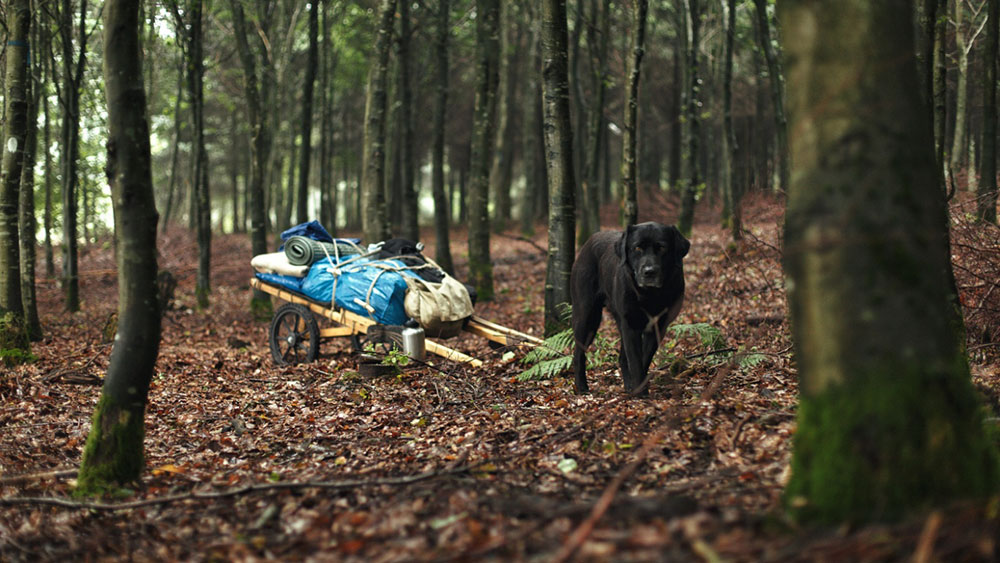
The main catalyst for the cart was my dog Spot. Spot struggled with van travel, often panting and uncomfortable during drives. Traveling by foot seemed like the natural choice, but carrying a pack would be to heavy because of the dog food and wasn't sustainable for long periods. Traveling by cart seemed like the perfect solution.
The cart solved the weight problem and served as a playful step toward inventing a life that didn't just consume modern comforts but embraced simplicity, nature, and self-reliance.
The build
Before the cart came to life, it lived in numerous sketches—exploring designs like box carts, backpack rigs, and one-wheelers. The design had strict demands: it needed to be dismantlable for hitchhiking, easy to carry as a backpack, and repairable in "the wild". I settled building the cart with using very simple materials, wood and rope.
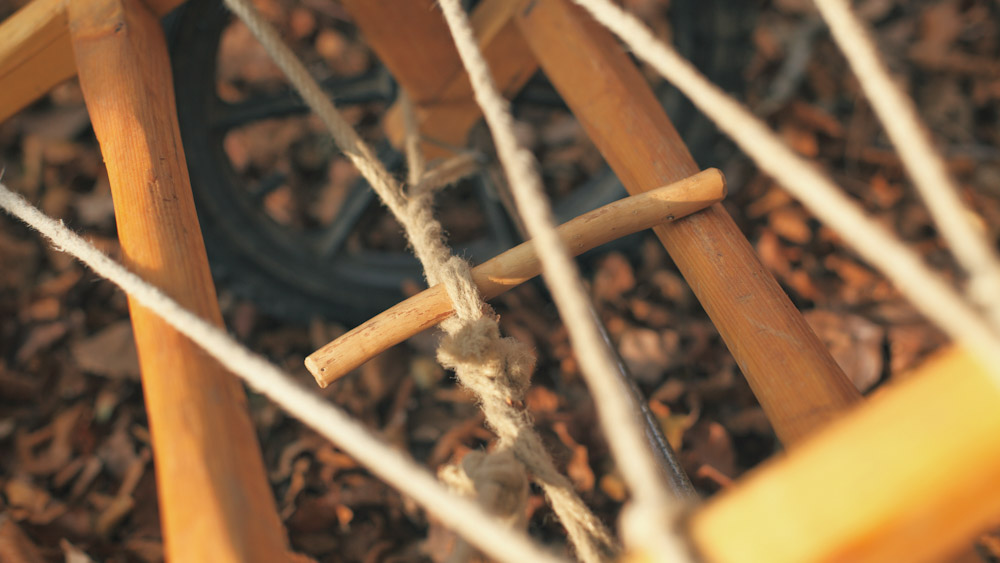
The cart is held together entirely by wood and rope. No screws, nails, or factory-made hardware were used (aside from the wheels and axle). The wood acts as the rigid "bones" while the rope acts as the "muscles and ligaments," tightly holding the structure of the frame.
Semi-Flexible Strength: Because it's bound by rope, the frame flexes upon impact instead of snapping like a rigid metal or screwed wooden frame would.
Dismantlable: Tension from the ropes can be quickly loosened, allowing the whole chassis to fall apart. This makes it possible to stow the pieces away into a backpack to hitchhike or jump on public transport.
High Center of Gravity: The larger mass sits up high. While this makes it prone to tipping on steep trails, it prevents the cart from sinking into mud and makes it much easier to push through tall grasses and brush.
Repair & Self-reliance: When a piece is lost or broken, there is no need for a specialized mechanic or tools. Armed with just a chisel, a folding saw, and a woodworking knife, broken struts can be replaced by foraging fresh branches from the woods.
Rolling effortlessly: Surprisingly even with a lot of weight the pushing of the cart is fairly easy. It's a matter of losing the cart in a balanced way. On flat surfaces it rolls smoothly and you can keep it going with very little effort.